

DBSFW_EM · Dragon Ball Super: Fusion World
Fusion World Energy Markers
304 cards, led by Energy Marker (E-90) (Gold) at $1,365.78.
Released Feb 14, 2024
Set index · DBSFW_EM
92.47
−7.53 (−7.53%)1Y
- 1W
- −0.92%
- 1M
- −7.55%
- 1Y
- −7.53%


The 5 most valuable · $929.54 – $1,365.78
- Cards
- 304
- Priced printings
- 304
- Sales a week
- 139
- Set value
- $35,211
- Popularity
- 95/100
- Standing
- #1
The index
A score that starts at 100 and moves with the set's fair value, compared on the same printings week to week.
One Near Mint copy of every printing at fair value; the chase cards move it most.
Master set value
one of every printing · fair value · Nov 12, 2026
- NM
- $35,211.06
- 304 of 304 priced · 94% from sales
- LP
- $21,724.84
- 304 of 304 priced · 79% from sales
- MP
- $18,744.27
- 304 of 304 priced · 61% from sales
- HP
- $15,953.69
- 304 of 304 priced · 32% from sales
- DMG
- $13,365.57
- 304 of 304 priced · 2% from sales
Near Mint was $35,078.13 on Aug 30, 2026 (+0.4%). Totals move when printings are added or first priced; the index above doesn't.
Cards
304 of 319 valued in Near Mint

Energy Marker (E-90) (Gold)
None$1,365.78
Energy Marker (E-42) (Gold)
None$1,055.00
Energy Marker (E-58) (Gold)
None$969.79
Energy Marker (E-73) (Gold)
None$951.87
Energy Marker (E-22) (Dragon Ball Games Battle Hour 2025 Promo Card Set)
None$929.54
Energy Marker (E-81) (Gold)
None$872.02
Energy Marker (E-60) (Gold)
None$835.49
Energy Marker (E-54) (Gold)
None$820.33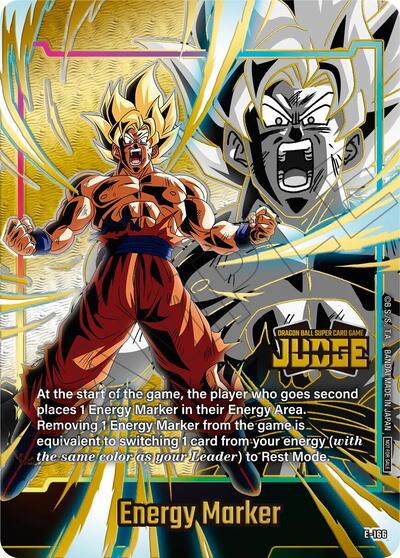
Energy Marker (E-166) (Judge)
None$801.30
Energy Marker (E-44) (Gold)
None$733.18
Energy Marker (E-75) (Gold)
None$726.60
Energy Marker (E-87) (Gold)
None$718.50
Energy Marker (E-79) (Gold)
None$705.69
Energy Marker (E-57) (Gold)
None$585.61
Energy Marker (E-82) (Gold)
None$535.88
Energy Marker (E-51) (Gold)
None$532.64
Energy Marker (E-45) (Gold)
None$496.07
Energy Marker (E-83) (Gold)
None$473.19
Energy Marker (E-56) (Gold)
None$468.11
Energy Marker (E-160)
None$461.63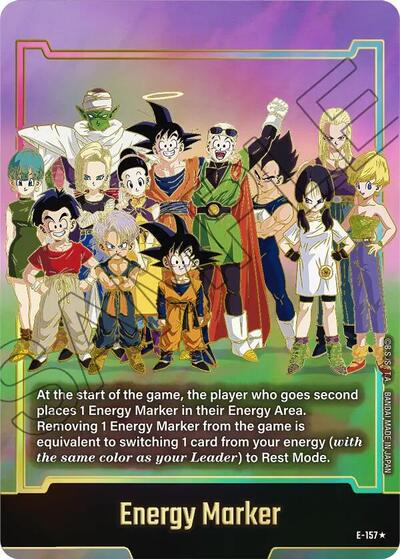
Energy Marker (E-157) (Gold)
None$439.00
Energy Marker (E-26) (Dragon Ball Games Battle Hour 2025 Promo Card Set)
None$434.14
Energy Marker (E-53) (Gold)
None$431.13
Energy Marker (E-71) (Gold)
None$416.81
Energy Marker (E-69) (Master Rank Version)
None$400.97
Energy Marker (E-84) (Gold)
None$398.03
Energy Marker (E-55) (Gold)
None$397.54
Energy Marker (E-49) (Gold)
None$396.17
Energy Marker (E-100)
None$392.77
Energy Marker (E-46) (Gold)
None$382.69
Energy Marker (E-150) (Gold)
None$370.00
Energy Marker (E-70) (Gold)
None$362.44
Energy Marker (E-76) (Gold)
None$337.61
Energy Marker (E-72) (Gold)
None$335.03
Energy Marker (E-80) (Gold)
None$329.66
Energy Marker (E-78) (Gold)
None$326.20
Energy Marker (E-24) (Dragon Ball Games Battle Hour 2025 Promo Card Set)
None$322.72
Energy Marker (E-62) (Gold)
None$320.46
Energy Marker (E-77) (Gold)
None$317.89
Energy Marker (E-85) (Gold)
None$296.43
In the set
319 singles tracked
- None319 · 100%
How to read the set index
- What is the set value?
- What it costs to own one Near Mint copy of every printing in the set, at fair value. Fair value comes from real sales only; the marketplace's Market Price is shown on card pages but never counted.
- What does the index line show?
- The Set Value Index: one Near Mint copy of every printing at fair value, compared week to week on the same printings, so it moves with the set's value — the chase cards most. It starts at 100; the change beside the set value is that line over 30 days, or over 7 for a set too new for a month. Beside it, the set without the chases (every card counted the same) and the chases on their own.
- How is popularity scored?
- Out of 100, against the rest of the game: how much the set's cards sell for, how many of them sell each week, how many cards it holds and how its index has moved. It ranks sets; it isn't a price.